About This Food
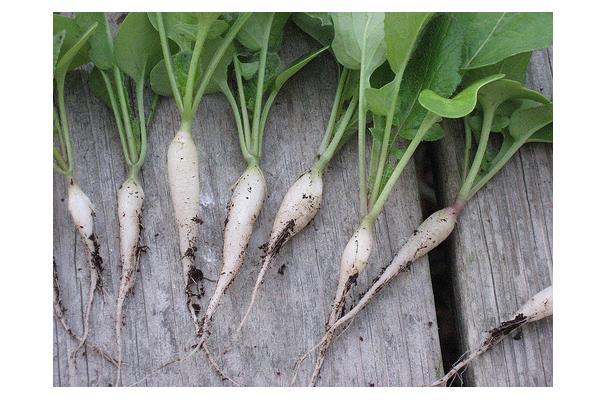
The Icicle Radish is an elongated white radish. It is typically much larger than the common salad radish and slightly spicier.
Information
Other names: White Transparent, White Naples, White Italian
Translations: White Icicle Redīsi, Baltoji Varveklis Ridikėlis, Sloi de gheaţă alb ridiche, Bijela Icicle rotkvica, Củ cải trắng cục nước đá, Rzodkiew biała Icicle, White Icicle Radijs, हिमलंब सफेद मूली, White Radish Icicle, Белый Исикл Редька, Λευκό παγοκρύσταλλος Ρεπάνι, الفجل الأبيض رقاقة الثلج, 화이트 고드름 무, Bílá Icicle ředkvičky, White Icicle Lobak, Yelong bitin White labanos, 白萝卜艾西克尔, Blanc caramell Rave, Bela Ledenica redkve, Biela Icicle reďkovky, White Icicle Ravanello, לבן נטיף קרח צנון, Vit Icicle Rädisa, Бела Ицицле Ротквица, ホワイトアイシクル大根, Radis blanc Icicle, White Icicle Radieschen, White Icicle Radise, Hvit istapp reddik, Blanco carámbano Rábano, Білий Ісікл Редька, Valkoinen Jääpuikko Retikka, Бяла Icicle репички
Physical Description
This is a long cylindrical radish with smooth white flesh.
Colors: creamy white or off-white with green or purple shoulders
Tasting Notes
Flavors: spicy
Mouthfeel: Crunchy, Crisp
Wine complements: Sauvignon blanc
Substitutes: Other radish varieties, White carrots
Selecting and Buying
Seasonality: january, february, march, april, may, june, july, august, september, opctober, november, december
Choosing: Radishes should have a fresh, earthy scent. They should be uniformly firm and smooth with no soft spots or blemishes.
Buying: You can find these radishes at farmer's markets during the spring. Some grocery stores with a wide variety of ethnic foods will also carry them.
Procuring: The Icicle Radish grows best in the early spring before the days get warm. They grow most easily in loosened soil, but the roots are capable of penetrating even thick clay. Keep them well watered to prevent woody or overly spicy radishes.
Preparation and Use
Radishes are most commonly used as a salad ingredient or as an ingredient on a vegetable tray with dip. Large radishes can be used to make kimchee, and smaller radishes can be sliced and added to other sauteed or stir fried vegetables. These radishes can also be pierced with a fork and baked with other root vegetables like turnips, carrots, or parsnips.
Cleaning: Radishes should be rinsed in clean, cold water to remove any remaining dirt. The area where the leaves attach to the root and the bottom of the root should both be removed. Then the radish can be sliced as the recipe requires. The tough skin that was exposed to the sun may need to be peeled or cut off.
Conserving and Storing
Radishes can be cleaned and cut up before storing in the refrigerator. They may be stored for up to a week if they are kept slightly moist but not wet.