Total Steps
8
Ingredients
18
Tools Needed
6
Ingredients
- 1 tablespoon parsley
- 1 leek leek, finely chopped
- 5 cup pheasant stock or chicken stock
- 3 tablespoon dry white wine
- 1 tablespoon Cognac
- fresh black pepper
- 1 teaspoon salt
- 1 bay leaf bay leaf, crumbled
- 1 teaspoon thyme leaves, very finely chopped
- 1 tablespoon finely chopped shallots
- 1 pound pork butt, chopped fine
- 1 chicken liver chicken liver
- 1 black truffle black truffle, coarsely chopped
- 1 pheasant liver pheasant liver
- 12 ounce pheasant meat
- 2 pheasant breasts pheasant breasts (approx. 6 oz)
- 6 strips lard
- 1 piece large caul fat
Instructions
Step 1
In a food processor, <a href="/technique/7S3QCKWK/mix">mix</a> the pheasant meat, (put aside the breasts), the pork butt, the shallots, thyme, bay leaves, leeks, parsley, <a href="/technique/DPSVTKVY/salt">salt</a>, pepper, cognac and white wine. Put the mixture into a bowl and put the breast meat, livers and the truffle on <a href="/technique/R34ZSY3M/top">top.</a> Cover and set aside in the refrigerator for 4 days.
Step 2
When you are ready to fill the <a href="/technique/3YM4FPT5/terrine">terrine</a>, <a href="/technique/6L7QNTJV/chop">chop</a> the liver, truffles and the pheasant breasts to make it easier to spread them out into a layer in the pate.
Step 3
Line the mould you have chosen for the pate with a piece of plastic <a href="/technique/X75YQJ6B/wrap">wrap.</a> <a href="/technique/4NXSJQ3D/press">Press</a> it down into the corners of the mould. Then lay your caul fat over the inside of the <a href="/technique/X75YQJ6B/wrap">wrap.</a> Fill one third of the mould with the forcemeat. Then arrange half the <a href="/technique/F7X2MV2G/lard">lard</a>, breast meat, livers and truffle in the middle. Add one third more forcemeat, then the remainder of the <a href="/technique/F7X2MV2G/lard">lard</a>, breast meat, livers and truffles. Cover with the remainder of the forcemeat.
Step 4
<a href="/technique/8M4FMXQ6/fold">Fold</a> the caul fat back over onto the pate. Cover the pate with tin foil and <a href="/technique/RNT367Z2/bake">bake</a> it in a <a href="/technique/Y8FLVD37/bain-marie">Bain Marie</a> in the oven for 2 hours, or until the internal temperature has reached 150 degrees Fahrenheit and a knife inserted in the middle comes out very hot.
Step 5
When the pate has cooked, remove it from the oven, place a foil-covered brick or kitchen weights on <a href="/technique/R34ZSY3M/top">top</a> and allow it to <a href="/technique/GZFHJC5K/cool">cool</a> overnight. Flavours develop after a day, so if you <a href="/technique/TPWNYF5L/can">can</a> leave it for a day it will be even better.
Step 6
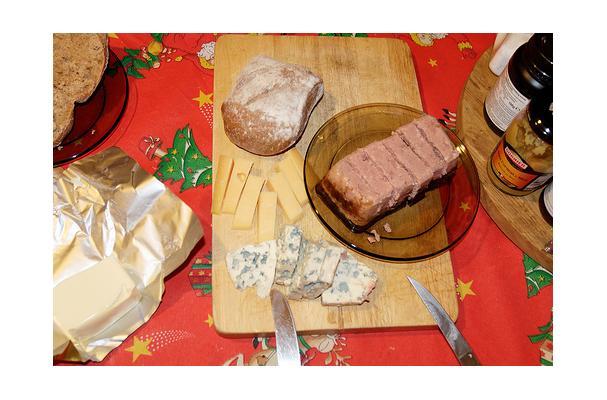
Remove the pate from the mould. <a href="/technique/3JDX2Q84/slice">Slice</a> and <a href="/technique/Y6MVNCHX/serve">serve</a> with toast, <a href="/technique/5LQDVZ7L/pickle">pickles</a> and chutney.
Step 7
Preparation time is 1 hour, 5 days including cooking and resting
Step 8
<a href="/technique/H3S4YV46/preheat">Preheat</a> the oven to 330 degrees Fahrenheit