


Purple Garden Sage
About
Sage (Salvia officinalis) is native to the Mediterranean and naturalized throughout Europe and North America. Known as garden sage, meadow sage, and true sage, this pungent herb is a member of the Lamiaceae, or mint, family. The genus name is taken from the Latin salvare meaning "to save." The specific name officinalis indicates that sage was included on official lists of medicinal herbs. There are numerous species of sage, including clary sage (S. sclarea) named because of its traditional use as an eyewash. Native Americans used the roots and leaves of lyre-leafed sage (S. lyrata L.), also known as cancerweed, as a salve for sores and in a tea to treat colds and coughs. Another species, known as divine sage (S. divinorum), a native of Oaxaca, Mexico, has been used for centuries by local shamans to achieve altered states of consciousness in healing rituals. There are many more garden varieties, including red or purple sage (S. officinalis purpurascens), which is valued particularly for its medicinal purposes.
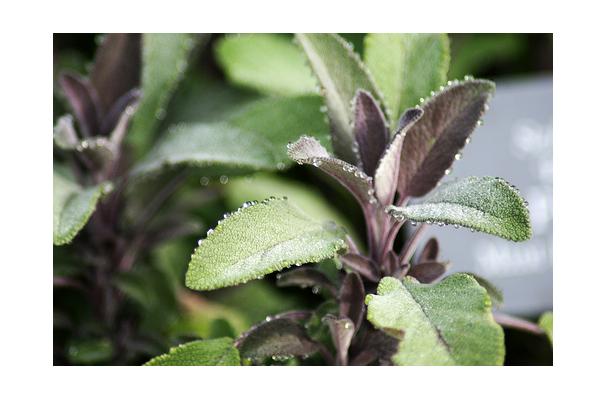
Sage thrives in full sun and well-drained soils, growing wild in some areas. It is a hardy evergreen shrub with a deep taproot and an erect root stalk that produces woody, square, slightly downy, branching stems that may reach a height of 4 ft (1.2 m). This familiar garden perennial has long, light-green leaf stalks that bear simple opposite lance- or oval-shaped leaves. The strong and pliable leaves are veined, with a velvet-like somewhat crinkled texture and may grow to 2 in (5.1 cm) long in some varieties. Leaf margins resemble a fine embroidery finish with rounded minutely toothed edges. They are a gray-green on the top and lighter on the underside. The entire plant is strongly aromatic, with a familiar pungency. Fresh leaves are bitter to the taste. Sage blossoms in the middle of summer with small white, blue, or purple flowers.


