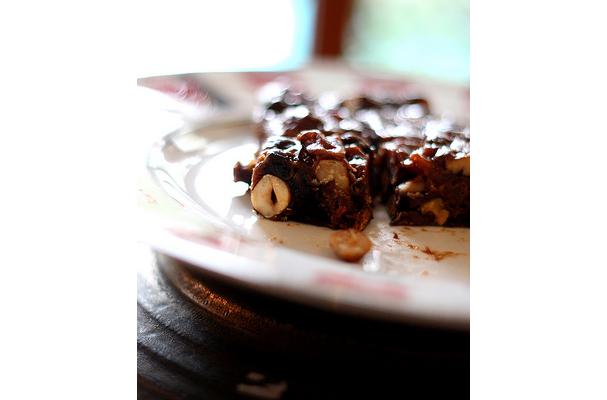
Recipe: Panforte [edit]

Other Names: Panforte Di Siena
Photo: Flickr user
Photo helpful? Yes No
  • Panforte
  • panforte
  • A surprise present from Bytemark Hosting
  • Raspberry Macadamia Panforte - Weston's Nut Farm
  • DSCN4355

Related Blogposts

Bloggers, have you written about Panforte? Add a widget!

Related Content

Wikipedia

Panforte is a traditional Italian dessert containing fruits and nuts, and resembling fruitcake or Lebkuchen. It may date back to 13th century Siena, in Italy's Tuscany region. Documents from 1205 show that panforte was paid to the monks and nuns of a local monastery as a tax or tithe which was due on the seventh of February that year. Literally, panforte means "strong bread" which refers to the spicy flavour. The original name of panforte was "panpepato" (peppered bread), due to the strong pepper used in the cake. There are references to the Crusaders carrying panforte, a durable confection, with them on their quests, and to the use of panforte in surviving sieges. The process of making is fairly simple. Sugar is dissolved in honey and various nuts, fruits and spices are mixed together with flour. The entire mixture is baked in a shallow pan. Currently there are many shops in Italy producing panforte, each recipe being their jealously guarded interpretation of the original confection and packaged in distinctive wrapping. Usually a small wedge is served with coffee or a dessert wine after a meal, though some enjoy it with their coffee at breakfast. In Siena — which is regarded by many, not least most inhabitants of that city, as the panforte capital of Italy — it is sometimes said that panforte should properly contain seventeen different ingredients, seventeen being the number of Contrade within the city walls.

Read more at Wikipedia...

Comments

Leave a Comment

You need to sign in or sign up to leave a comment.
Print this pageEmail this pageShare on FacebookShare on TwitterStumble this page
Yield: 1 inch round

[edit] Ingredients

Nonstick cooking spray, for pan

3

cups whole blanched almonds

1 ¾

cups whole hazelnuts, skinned or unskinned

2

cups diced candied orange peel

6

ounces dried apricots, diced

5

ounces dried figs, diced

1

cup unbleached all-purpose flour

2

tablespoons ground cinnamon

1

tablespoon Dutch-processed cocoa powder

1

teaspoon coarse salt

1

teaspoon ground nutmeg

½

teaspoon ground cloves

¼

teaspoon freshly ground black pepper

1 ¾

cups granulated sugar

1 ¾

cups honey

6

tablespoons (¾ stick) unsalted butter, plus more for pan

Confectioners’ sugar, for dusting

[edit] Preparation

Step 1

Preheat oven to 325 degrees with a rack set in the center of the oven. Generously spray a 9-by-2-inch heavy-bottomed, nonstick round cake pan with nonstick cooking spray. Line bottom of pan with a parchment paper circle, spray parchment paper circle with cooking spray. Coat bottom and sides of pan with flour, tapping out excess.

Step 2

Using a sharp knife, roughly chop almonds and hazelnuts and place in a large, wide bowl, along with orange peel, apricots, and figs; toss to combine.

Step 3

In a medium bowl, stir together flour, cinnamon, cocoa powder, salt, nutmeg, cloves, and pepper. Add to bowl of nuts and fruit and toss until well combined.

Step 4

Place sugar, honey, and butter in a medium saucepan over medium heat. Cook mixture until it reaches 217 degrees on a candy thermometer. Remove pan from heat and quickly pour sugar mixture into nut mixture. Using a heatproof spatula, stir until well combined. Transfer mixture to prepared cake pan, smoothing surface with a spatula.

Step 5

Transfer cake pan to oven and bake until entire surface is bubbling, 15 to 20 minutes. Transfer cake to wire rack and let cool completely. Wrap well with parchment paper, and then again with plastic wrap.

Step 6

To serve, dust the panforte with confectioners’ sugar and cut into thin wedges with a sharp knife.

[edit] About Panforte

Store in a cool, dry place up to 3 weeks.

Related Recipes